Source the cheapest clean resources
We aggregate — and where it pays off, help manufacture — the best-cost solar panels, batteries, and GPUs.
Where the models run, where the power comes from, and where the network is headed.
Today, Interdata already runs on existing datacenters in Paraguay — one of the cleanest grids on Earth, powered almost entirely by hydroelectric dams like Itaipú (≈14 GW). The rest of our compute runs on GPUs we rent by the hour. Either way, Interdata runs a lean stack — small models on right-sized hardware — so every request burns far less energy than a hosted frontier model. Cheaper compute is cleaner compute, wherever the GPU lives. Looking ahead, our plan is to scale the same economics down to a single house: your own always-on, self-serving macro-datacenter — and we're building the repeatable, low-cost path to get there.
Grams of CO₂ per kWh (illustrative — IEA / Our World in Data ranges). Paraguay's near-100% hydro grid is roughly 20× cleaner than the global average — and a lean Interdata stack draws less of it, so the compute we run there is almost carbon-free.
The vision: as solar and battery prices keep falling and clean hydro power stays cheap, the economics that make Interdata's datacenter work scale down to a single home — turning any house into its own always-on AI compute node.
The repeatable path to your own node The plan
The vision only matters if it's buildable. Interdata's goal is to make it repeatable — sourcing, and where it pays off manufacturing, the best-cost clean-energy and compute hardware, so you can self-build a datacenter node at home for a fraction of today's cost.
We aggregate — and where it pays off, help manufacture — the best-cost solar panels, batteries, and GPUs.
A repeatable blueprint to self-build a home compute node, powered by your own solar, storage, and clean grid.
Power your own always-on AI, and put spare compute to work instead of paying a hosted provider by the token.
A rough sketch of where the repeatable path leads: a single house in Ciudad del Este, Paraguay, running its own compute on rooftop solar and battery storage — one self-serving node, powered the same clean way as the datacenters we already use today.
Concept sketch of a single self-serving node: rooftop solar — backed by Paraguay's hydroelectric grid — charges a battery that powers an always-on macro datacenter, the same clean setup as the datacenters Interdata runs on today.
Interdata isn't one datacenter — it's a growing network of interconnected macro-datacenters, some on Paraguay's hydro grid, others on rented GPUs. Connect your application to Interdata and you reach every model hosted anywhere in the network, through one endpoint — no matter which datacenter actually runs it.
The circled nodes run in Paraguay on the hydro grid; the others are rented GPUs — RunPod, AWS SageMaker, and more. Every node interconnects, so a single application can call any model across the whole network — Llama, Qwen, Mistral, Gemma4, 1-bit Bonsai — from one endpoint.
Every node we move south improves both numbers that matter: cost per GPU-hour and grams of CO₂ per request. Our compute partner in Paraguay runs off Itaipú, with hydro and immersion cooling and bare-metal capacity available today.
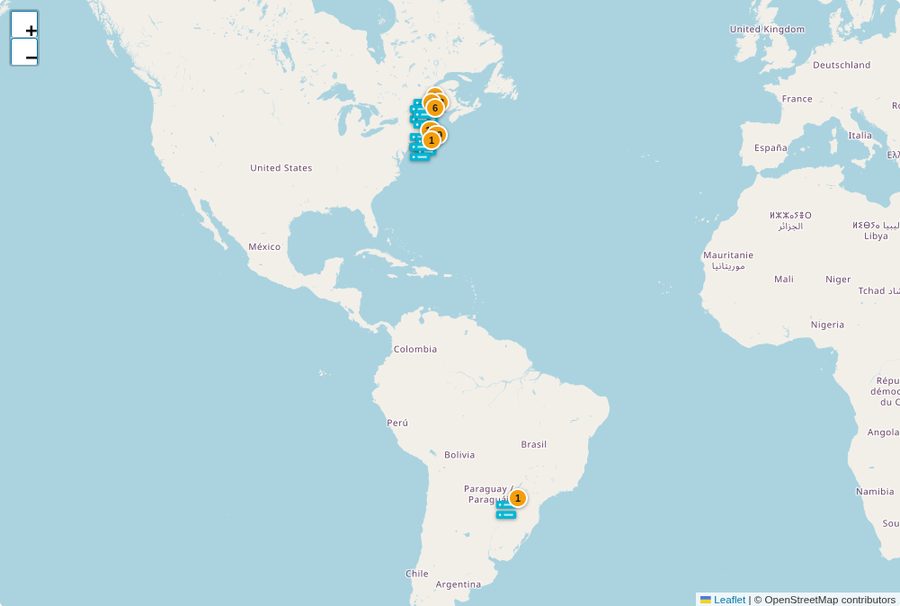
Four nodes in North America on rented GPU capacity, two in South America. Zeta Banco is already served from Paraguayan compute.
Capacity figures are the operator's own published numbers. We're also in conversation with providers in Encarnación, Ciudad del Este and Santiago, Chile — facilities where power, land, cooling and security are already solved.
Tell us what your team runs today. In 30 minutes we'll show you what can move to open models, where it would run, and what your proposal would look like.